

Vega Runtime is the product layer that turns an approved request into Capability-grounded work. It does not make a robot generally capable of every requested outcome. Its behavior remains bounded by the Runtime's readiness, deployment policy, and the Capabilities available in the current environment.
Concepts
| Term | Meaning |
|---|---|
| Vega Runtime | The product that operates Vega work in a deployment. |
| Task | A tracked unit of requested work with an observable lifecycle and outcome. |
| Session | An operational period during which the Runtime is active. |
| Capability | A separately packaged, bounded function that can perform defined work. |
| Capability gap | A requested outcome cannot be performed because an eligible Capability is unavailable. |
| Recovery | The Runtime's behavior for assessing interrupted work and returning to a known operational position. |
Position in the Vega platform
Vega Runtime is one part of the Vega platform. The Runtime operates product behavior. The Vega SDK, Vega Capability Protocol (VCP), and Capability packages provide the public ecosystem through which compatible functionality can be developed and described.
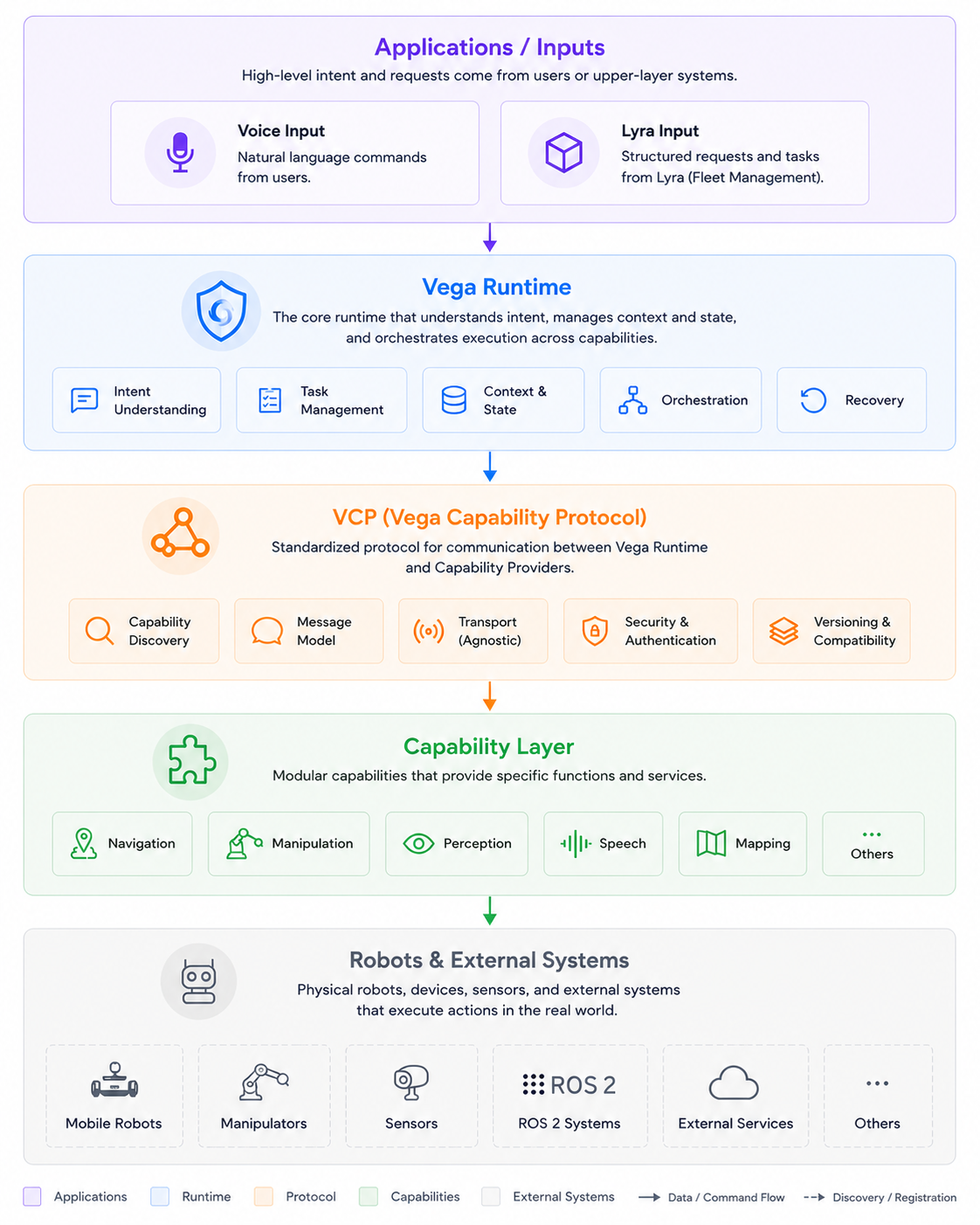
The Runtime uses Capability declarations and their supported behavior to coordinate work. The SDK helps Capability authors build compatible packages. VCP defines the public compatibility contract. Capability packages provide the robot-, device-, or service-specific function. Neither the SDK, VCP, nor a Capability package exposes Vega Runtime's proprietary implementation.
Responsibilities
Vega Runtime is responsible for the following observable behavior:
- Accepting supported work when the Runtime is ready.
- Tracking task lifecycle and reporting task outcomes.
- Establishing and managing operational sessions.
- Coordinating work with eligible installed Capabilities.
- Maintaining continuity for supported work across normal operation.
- Assessing interrupted work during recovery.
- Presenting public lifecycle, health, and status information.
Vega Runtime is not responsible for robot drivers, ROS implementation, AI model implementation, Capability implementation, SDK implementation, or the VCP specification. Those responsibilities remain with the relevant hardware, provider, SDK, or protocol owner.
Typical Runtime workflow
At a product level, work follows this flow:
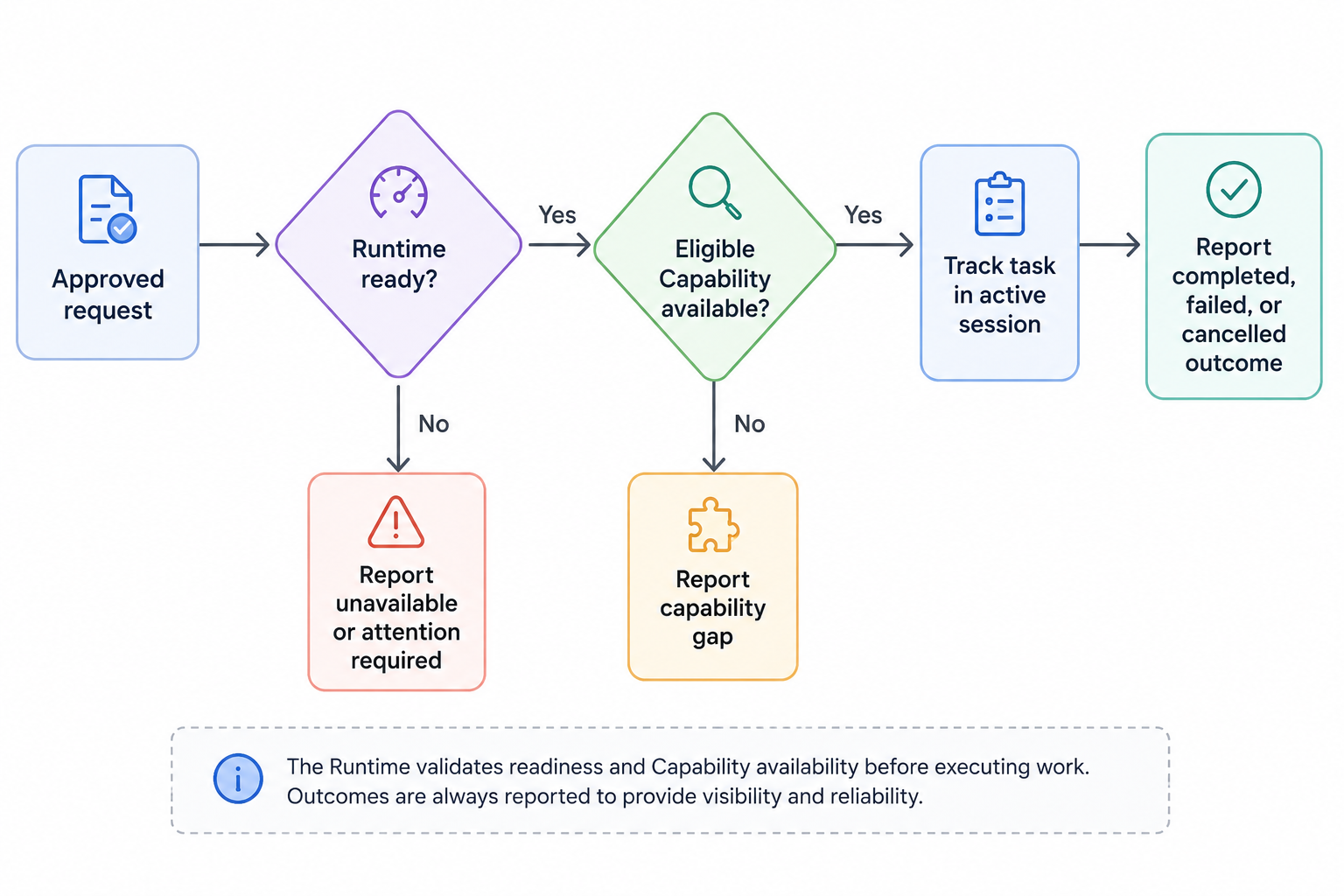
For example, an operator requests an approved spoken announcement. If the deployment is ready and an eligible speech Capability is available, Vega Runtime coordinates the work and reports its outcome. If the Capability is unavailable, the Runtime reports that condition rather than claiming a result.
Runtime lifecycle
Vega Runtime has observable lifecycle stages. It accepts work only after it reports ready. During shutdown, it stops accepting new work and follows the deployment's approved stop handling. A restart begins a new active operational period and may trigger recovery assessment for prior interrupted work.
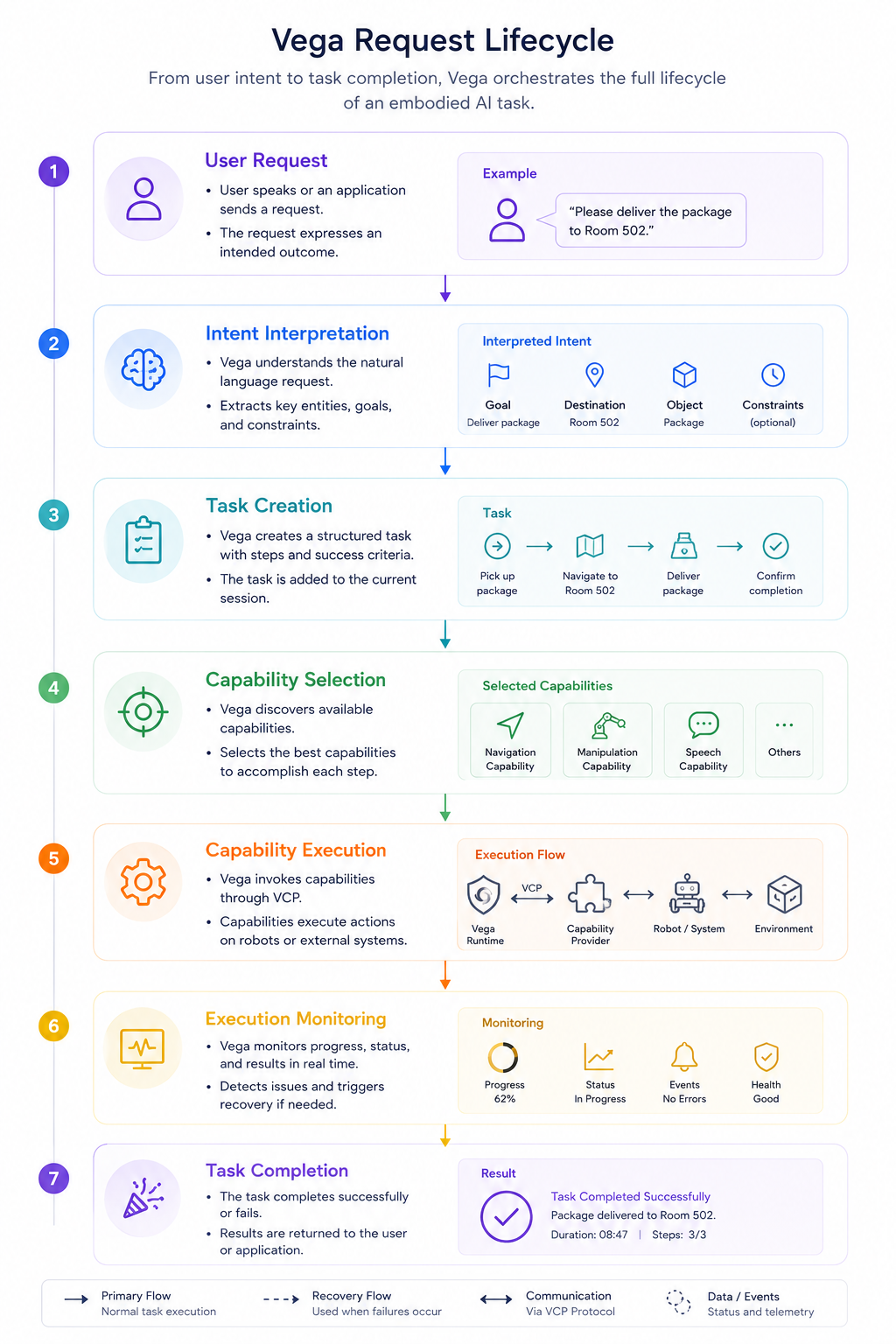
High-level guarantees
Vega Runtime provides the following high-level behavioral guarantees:
- It does not present unavailable Capability work as a completed outcome.
- It keeps work within its active task and session context.
- It reports readiness and visible operational status before accepting work.
- It supports recovery assessment for interrupted work where the deployment and Capabilities provide the required information.
- It distinguishes known outcomes from conditions that need operator attention.
These guarantees do not replace hardware safety systems, site procedures, or Capability-specific limitations. A software cancellation or process exit alone does not prove that an external or physical action ended.